An administrative lawsuit between Sheyang Xin'an Te Wire and Cable Factory (hereinafter referred to as Xin'an Te Wire and Cable Factory) and Louis Vuitton Malletier (hereinafter referred to as Louis Vuitton) over the trademark No. 9291725 (hereinafter referred to as the disputed trademark) lasted four years. In June 2019, the case was concluded and Louis Vuitton won.
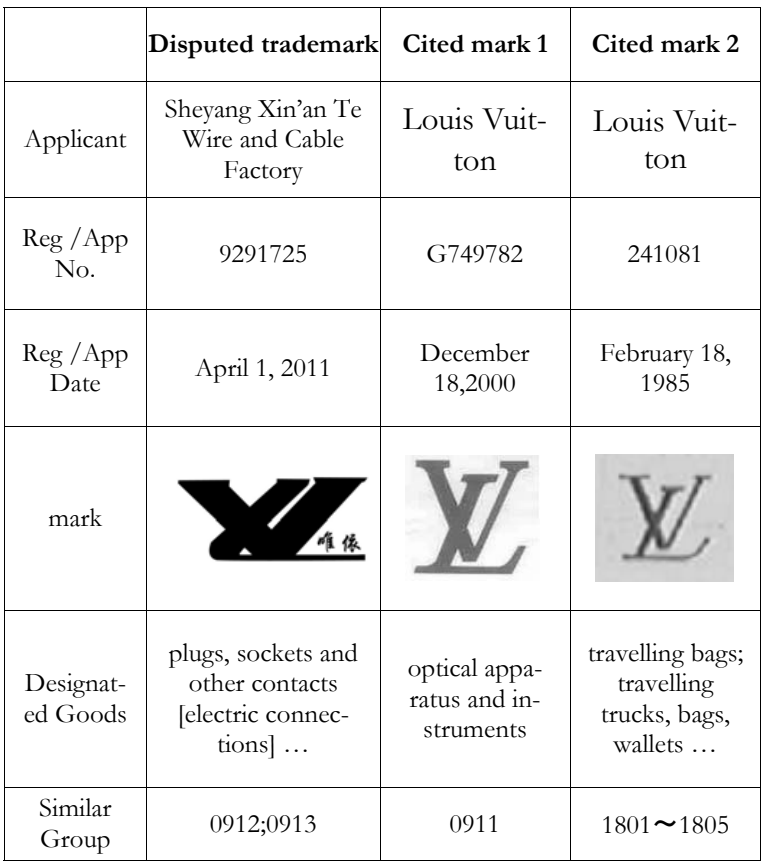
The disputed mark was filed by Sheyang Xin’an Te Wire and Cable Factory on April 1, 2011, for plugs, sockets and other electrical contacts, among other goods, in subclasses 0912 and 0913. Cited mark 1, G749782, was registered/applied for on December 18, 2000, for optical apparatus and instruments in subclass 0911. Cited mark 2, No. 241081, was registered/applied for on February 18, 1985, for traveling bags, trunks, wallets and related goods in subclasses 1801–1805. Both cited marks belonged to Louis Vuitton.
Case Summary
In April 2011, Xin'an Te Wire and Cable Factory filed a registration application for the disputed trademark with the Trademark Office. The application was approved for registration in May 2012 for goods “wires, cables, etc.” in class 9.
In December 2015, Louis Vuitton filed a request for invalidation of the disputed trademark with the Trademark Review and Adjudication Board (hereinafter referred to as the TRAB), claiming that the disputed trademark is similar to its earlier mark "LV" No. G749782 (cited mark 1 as shown in the table) on similar goods, and its earlier mark “LV” No. 241081 (Cited Mark 2 as shown in the table) has become a well-known trademark while the disputed mark is a malicious copy and imitation of cited mark 2, so the registration and use of the disputed mark will lead to confusion among consumers, and bring damages to its interest. To support these claims, Louis Vuitton filed evidence of use of its business name, products and cited marks in this invalidation procedure.
Decision of the TRAB
The TRAB held that, the disputed mark is different from the cited mark 1 in respect of whole composition and reading, the designated goods of the two marks are not similar either, so the two marks do not constitute similar marks. Meanwhile, the evidence provided by Louis Vuitton could prove that the cited mark 2 has high reputation in China, but the disputed mark is very different from the cited mark 2 on the whole appearance, and its designated goods in class 9 are very different from the famous bags, suitcases with the cited mark 2, so the registration and use of the disputed mark is not easy to mislead the public.
On that basis, the TRAB made a decision to maintain the registration of the disputed trademark. Louis Vuitton was not satisfied with this decision, and filed an administrative lawsuit with the Beijing Intellectual Property Court.
Judgment of First Instance
Beijing Intellectual Property Court (Court of First Instance) held that the disputed trademark and the cited trademark 1 are very similar in terms of word composition, overall appearance and visual effect so they constituted similar marks.
As to whether the registration and use of the disputed mark will damage the interests of Louis Vuitton’s cited mark 2, the Court of First Instance held that the evidence submitted by Louis Vuitton was sufficient to prove that before the application date of the disputed mark, it had continuously and extensively advertised and used the cited mark 2 in China, and the cited mark 2 had a high reputation among the relevant public, which constituted a well-known trademark. The disputed mark is very similar to the cited mark 2 in word composition, overall appearance and visual effects, and it is a copy and imitation of the cited trademark 2. Although the designated goods of the disputed mark are not similar to the goods of the cited mark 2 according to the Classification, based on the well-known degree of the cited trademark 2 in luggage goods, the use of the disputed trademark is likely to cause confusion and misunderstanding among the relevant public, resulting in damage to the interests of Louis Vuitton.
Accordingly, the Court of First Instance revoked the TRAB’s decision and ordered them to make a new decision. The TRAB refused to accept the decision, and then appealed to the Beijing Higher People's Court.
Final Judgment
Like the court of first instance, the Beijing Higher Court held that the evidence submitted by Louis Vuitton could identify the cited mark 2 as a well-known trademark on bags, suitcases, etc. The disputed mark is highly similar to cited mark 2 in word composition, overall appearance and visual effect, which constitute the duplication and imitation of the cited trademark 2. Therefore, the use of disputed mark is liable to mislead the relevant public, resulting in damage to the interests of Louis Vuitton as the right holder of well-known trademarks. Accordingly, the Beijing High Court decided to reject the appeal of the TRAB and maintain the first instance judgment.
Source:https://www.zhiqianqiu.com/xwxq/1199.html