
1. Introduction
After filing an invention application, an applicant has several opportunities to amend the application on their own initiative, e.g., when a request for substantive examination is made or within three months after the application enters substantive examination, or when a PCT application enters the national phase or when a divisional application is filed. Generally, compared with amendments made in response to an office action, the amendments on one’s own initiative have fewer restrictions. For example, the applicant may amend or remove a technical feature within the content of the application as filed to expand the scope of the protection, or add a new dependent claim, etc., as long as the amendments to the application document of the invention or utility model do not go beyond the scope of disclosure contained in the initial description and claims.
Currently, the judgment on whether amendments go beyond the content of the application as filed is rather strict. In what circumstances can a technical feature be deleted without adding matter? Hereinafter, analysis will be given with reference to relevant regulations of the Patent Law of the People’s Republic of China and the Guidelines for Patent Examination and a detailed case.
2. Principles for assessing added matter
Article 33 of the Patent Law prescribes that “an applicant may amend his or its application for a patent, but the amendment to the application for a patent for invention or utility model may not go beyond the scope of disclosure contained in the initial description and claims”. This provision is abstract and can be difficult to apply in practice. Therefore, specific examples of unallowable additions, unallowable changes and unallowable deletions are listed in the Guidelines for Patent Examination.
The Guidelines for Patent Examination prescribe unallowable deletions in part II, Chapter VIII-5.2.3.3: “the technical features which are definitely determined as the essential technical features of the invention in the initial application are deleted from the independent claim, i.e., the technical features which are described as the essential technical features throughout the initial application are deleted”.
The Guidelines for Patent Examination prescribe in part II, Chapter II-3.1.2 that “‘Essential technical features’ refer to the technical features of an invention or utility model that are indispensable in solving the technical problem and the aggregation of which is sufficient to constitute the technical solution of the invention or utility model and distinguish it from the other technical solutions described in the background art”.
Thus, the judgment on whether the deletion of a technical feature from an independent claim goes beyond the content of the application as filed should involve a judgment on whether the technical feature being deleted is an essential technical feature. As to the judgment on whether the technical feature is the essential technical feature, this technical feature should be placed in the technical solution of the application in combination with the technical problem to be solved, and should be compared with the technical solution in the background art.
Hereinafter, the judgment on whether the deletion of a technical feature goes beyond the content of the application as filed is described with reference to a specific case.
3. Case study: Workpiece transport device
Claim 1
Workpiece transport device (1) for a machine that shapes workpieces (2) on exposed side surfaces (2') during their passage, having
at least one endlessly circulating transport belt (4), on the upper strand (4') of which the workpieces (2) are held by form and/or friction, and
having a fixed guide device (6) for the transport belt (4) that comprises a guide rail (8) holding the upper strand (4') along a transport section, where
the guide rail (8) on its upper side comprises a channel (8’) adapted to the form of the belt concerned and a base in which are disposed air outlet openings (10) connected with a compressed air source,
characterized in that
the workpiece transport device (1) comprises a linear guide element (12) designed to engage in a guide groove (2") provided in the workpiece (2) to be transported,
wherein the workpiece transport furthermore has at least one support skid (16) which extends laterally next to and substantially parallel to the transport belt (4), and the upper side of which is substantially flush with the upper side of the upper strand (4') of the transport belt (4), and at least one spring-mounted pressure rail (18) which extends above and substantially parallel to the support skid (16).
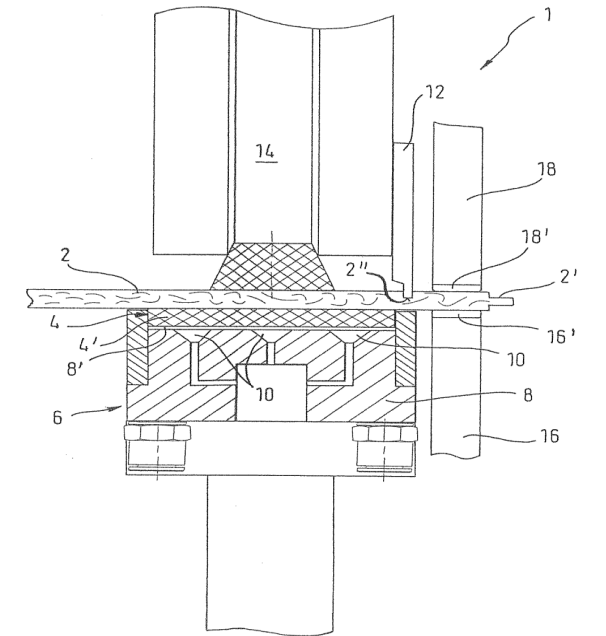
Voluntary amendments
Within three months after the application entered substantive examination, the applicant made voluntary amendments, including deleting the feature “a channel (8’) adapted to the form of the belt concerned” from the above claim and adding a dependent claim containing this deleted technical feature.
The examiner’s position
During the substantive examination, the examiner stated that the above amendments go beyond the scope of disclosure contained in the initial description and claims, since the technical solutions before and after this technical feature was deleted have a substantial difference and the technical solution after the technical feature was deleted cannot be determined directly and unambiguously according to the disclosure contained in the initial description and claims. The opinions of the examiner were as follows:
① The basis for judging whether amendments go beyond the content of the application as filed is “whether the amended contents are definitely described in the initial description and claims or can be determined directly and unambiguously according to the information recorded in the initial description and claims”, but not “whether the deleted technical feature is an essential technical feature”;
② In the original application document, the guide rail always includes the channel on its upper side. Besides this guide rail, no guide rails with other types or structures are described. After the applicant deletes the above technical feature, the guide rail may include the channel on its upper side or include no channel on its upper side. This obviously goes beyond the content of original application document. Based on the above, a decision of rejection was made.
The applicant’s arguments
The applicant argued that the above amendments do not go beyond the scope of disclosure contained in the initial description and claims, since the deleted feature “the guide rail (8) on its upper side comprises a channel (8’) adapted to the form of the belt (4) concerned” is not an essential technical feature of the present invention. The reasons were as follows.
① Essential technical features refer to the technical features of an invention or utility model that are indispensable in solving the technical problem and the aggregation of which is sufficient to constitute the technical solution of the invention or utility model and distinguish it from the other technical solutions described in the background art. However, the technical feature “the guide rail (8) on its upper side comprises a channel (8’) adapted to the form of the belt concerned” does not differentiate claim 1 from the background art.
② The present application does not definitely indicate that this technical feature is an essential technical feature.
③ This technical feature is not indispensable in solving the technical problem of the present application. The technical problem to be solved by the present application is that, “the workpiece to be machined is transported precisely and stably with high transport speeds”. Without this channel (8’), the transport belt can still endlessly circulate on the guide rail (8). Considering the technical feature “the linear guide element (12) is designed to engage in the guide groove (2") provided in the workpiece (2) on the transport belt (4)”, the positioning of the workpiece (2) during the transportation and processing is improved. The support skid (16) is substantially parallel to the upper side of the upper strand of the transport belt (4), which provides a particularly precise reference plane for the transported workpieces and a stable support for the workpieces 2 during the machining process. The spring-mounted pressure rail 18 cooperates with the support skid 16 to stably guide and precisely position the workpieces 2, and prevent their deviation during the machining process.
The above technical features can solve the technical problem of precisely and stably transporting the workpiece with high transport speeds and achieve the technical effect of machining the workpiece with low tolerances.
④ After deleting this technical feature, claim 1 can also achieve the technical effect of “the apparatus has a high transport speed and allows machining of the workpieces being transported with low tolerances” without amending the remaining technical features of claim 1.
Outcome
During the reexamination procedure, the board agreed with the arguments of the applicant and withdrew the decision of rejection of the present application.
4. Conclusion
The analysis supports the following conclusion. When an independent claim is amended, if a technical feature deleted from this independent claim is not an essential technical feature of the application and the deleted technical feature is independent of the other technical features, such amendment does not go beyond the scope of disclosure contained in the original description and claims and is in conformity with Article 33 of the Patent Law.
Although the amendment by way of deleting a technical feature is within the content of the application as filed, such deletion should be made when amendments on one’s own initiative are allowed. If the deletion is made when responding to an office action, the deletion will not be allowed by the examiner according to Rule 51, paragraph 3 of the Implementing Regulations of the Patent Law that “the amendments are not directed to the defects pointed out by the notification”. Therefore, the applicant should make appropriate use of the opportunities for voluntary amendment to amend the application document reasonably.