
The means of debt guarantee stipulated by the Civil Code of the People's Republic of China include guarantee, mortgage, pledge, lien and deposits. Any reference to pledge means that the debtor or a third party transfers its movable property to the creditor for possession or places its property rights under the creditor's control, as the security for the creditor's rights. If the debtor fails to pay his debts, the creditor shall have the right to appraise and accept the movable property or property rights, or enjoy the right of priority to apply the proceeds obtained from auction or sale of the movable property or property rights to satisfy his claim against the debtor in accordance with the Civil Code. Pledge includes a pledge of movable property and rights.
Patent rights are the subject of the pledged rights. The pledge of patent rights represents a way of guarantee by which the property rights in the patent rights are pledged by the debtor or a third party as a security for the realization of the creditor's rights. When the debtor fails to perform his obligations that become due, the creditor enjoys the right of priority to claim compensation from the appraised price for the property rights in the pledged patent rights. I. What is it for?
Patent rights being pledged as a security for debts are commonly applied for secured loans, debit and credit guarantee, security for rents on plants, etc. A debtor may have his own patent rights pledged as security. A debtor may be a pledgor, a third party may also be a pledgor, and a creditor is the pledgee. II. How does it work?
According to Article 227 of the Real Right Law, a written contract shall be concluded for pledge of patent rights. The pledged rights shall come into effect when the pledge registration is completed by the competent authority. This shows that the entry into force of a pledge contract is not equivalent to the establishment of the pledged patent rights unless the key legal procedures for pledge registration have been completed with the relevant competent authorities.
For patent rights, the competent authority concerned is China National Intellectual Property Administration (CNIPA). Therefore, if a patent right is pledged, the pledgor and the pledgee shall enter into a contract in writing and go through the registration formalities for pledge of the patent rights with CNIPA, by which the pledged patent rights shall take effect from the date of pledge registration.
Any reference to a contract for pledge of patent rights herein can be a separately concluded pledge contract, or a master contract containing pledge clauses. This contract must be concluded in writing, otherwise it will be null and void if made in oral form, via telephone, telegram or in other forms.
Why does the pledge of patent rights only take effect after registration? The reason lies in the particularity of patent rights. Patent rights are not stable, and they may become invalid due to overdue annual fees or reasons for invalidation, or be transferred by the patentee or licensed to others for exercise. Therefore, the validity of the pledge contract will not be equivalent to the establishment of the pledge of patent rights. After the pledge contract is registered, the pledged rights come into effect, and the pledgee's right of priority to claim compensation based on the security interest is established. Without the consent of the pledgee, the pledgor cannot dispose of the patent rights by means of assignment, license, etc. III. Procedures for the Registration of the Pledged Patent Rights 1.
Applicant for the Registration of the Pledged Patent Rights According to Article 14, Paragraph 3 of the Rules for the Implementation of the Patent Law of the People’s Republic of China, where a patent right is pledged, the pledgor and the pledgee shall go through the procedures for registration of the pledged rights with the patent administration department under the State Council. The pledgor shall be the patentee. If a patent is jointly held by several patentees, the pledgor shall stand for all the patentees, unless otherwise agreed to by and among the parties.
2. Person Responsible for Pledge of Patent Rights Foreigners, foreign enterprises or other foreign organizations without a habitual residence or business office in China shall entrust a legally established patent agency with the registration of the pledged patent rights. If a patent agency is entrusted with registration, an attorney shall be put in charge of the relevant procedures in the power of attorney.
3. Submission of an Application for the Registration of the Pledged Patent Rights The parties may go through the relevant procedures for registration of the pledged patent rights by submitting an application in electronic form or by post or in paper form at the service counter. The parties shall submit the following documents to CNIPA:
(1) an application form for registration of the pledged patent rights jointly signed or sealed by the pledgor and the pledgee; (2) a contract for pledge of patent rights; (3) the identity certificates of the pledgor and the pledgee, or the relevant letter of commitment signed by the parties; (4) if an agent is entrusted, a power of attorney indicating the authority of agency, which is signed or sealed by both the pledgor and the pledgee; and (5) other materials required. If the above documents are in a foreign language, a Chinese translation thereof shall be attached, and take precedence. Where the patent right has been subject to asset appraisal, an asset appraisal report shall also be submitted by the parties concerned.
What calls for special attention is that the amount of debts indicated in the master contract and pledge amount, i.e. amount of guarantee in the pledge contract, shall be filled out in the application form for registration of the pledged patent rights, with a brief description of the reasons for the pledge activity.
4. Approval of the Registration of the Pledged Patent Rights After receiving the applications for registration of pledge submitted by the parties concerned, CNIPA shall accept and review those applications within 5 working days from the date of receipt to decide whether or not to register the pledged rights. If an application is submitted online, CNIPA will review the application and decide whether to register the pledge within 2 working days. If flaws are found in the pledge applications submitted by the parties, the time limit for approval shall be counted from the date when the parties remove all the flaws.
Under the following circumstances, applications for pledge are commonly not approved:
(1) the pledgor is not the patentee recorded in the patent register when the party concerned applies for registration of pledge; (2) patent rights have been extinguished or declared invalid; (3) no patent rights have been granted for the patent application; (4) no annual fees have been paid for the patent rights in accordance with the regulations; (5) the patent rights are in a suspension or preservation period; (6) the time limit for the debtor to perform his debts exceeds the validity period of the patent rights; (7) the pledge contract is short of necessary information, including information on the parties, patents, the type and amount of creditor's rights, the duration of debts, and the scope of the pledge guarantee; (8) pledge of the co-owned patent rights is not made with the consent of all joint holders unless otherwise specifically agreed upon; (9) the patent rights have been applied for registration of pledge and are in pledge; (10) where an invention patent has been applied for the same invention made for the utility model of the same applicant who has applied for the pledge registration on the same day, except that the party concerned declares his agreement to continue the registration of the pledged patent rights after being informed of the situation; and (11) where invalidation proceedings have been initiated against the patent right, unless the party concerned declares his agreement to continue the registration of the pledged patent rights after being informed of the situation.
Before submitting a contract for pledge of patent rights, it would be better to confirm whether the pledged patent is valid and whether it has been invalidated or the same invention has been applied for on the same day.
5. Announcement of the Pledged Patent Rights If the application for registration of the pledged patent rights passes the examination, CNIPA shall register the same in the patent register, and give a "Notice of Registration of the Pledged Patent Rights" to the party concerned.
6. Revocation of the Pledged Patent Rights During pledge of patent rights, if CNIPA finds that the pledge registration falls into the circumstances under which applications for pledge are commonly not approved, or other circumstances under which the registration of the pledged patent rights should have been revoked, CNIPA will cancel the registration of the pledged patent rights by giving a "Notice of Revoking the Registration of the Pledged Patent Rights" to the party concerned. If registration of the pledged patent rights gets revoked, the pledge registration shall be null and void ab initio.
7. Rights of the Pledgor During pledge of patent rights, if the pledgor makes a request for waiver, transfer or license of the patent rights, no such request will be accepted by CNIPA unless the proof of the pledgee's consent is given at the same time.
Where the pledged patent rights are transferred or a license for the pledged patent rights is granted by the pledgor, the transfer fees or royalties received by the pledgor shall be applied to pay off his debts to the pledgee in advance or kept on deposit.
During pledge of patent rights, CNIPA will promptly notify the pledgee if:
(1) patent rights have been declared invalid or extinguished; (2) no annual fees have been paid for the patent rights within the prescribed period; and
(3) CNIPA has been requested to suspend the relevant procedures due to a dispute over the ownership of the patent rights, or the court has adjudicated that preservation measures be taken for the patent rights. IV. Registration of the Pledged Patent Rights in China The number of cases about registration of the pledged patent rights in China has increased year by year. According to our statistics on IncoPat data, from 2010 to 2022 (as at August 1, 2022), the number of cases about registration of the pledged patent rights is as follows:
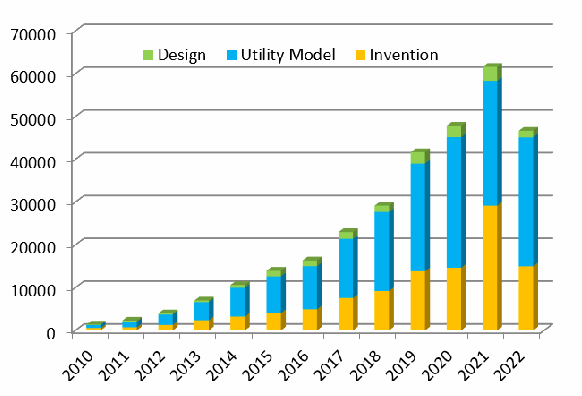
The number of cases about registration of the pledged patent rights in China has reached 61,590 in 2021, up 28% from 47,860 in 2020. Utility model patents have always been reported with the largest number of the pledged patents among the three types of patents. The proportion of the pledged invention patents has increased significantly. The number of the pledged invention patents in 2020 accounted for 30% of the total number of the pledged patents, up to 47% in 2021. The increase in the number of the pledged invention patents is stimulated by the policies and measures China has introduced in recent years related to pledge of intellectual property rights.
For example, the Notice of Further Strengthening Intellectual Property Rights Pledge Financing was given by the China Banking and Insurance Regulatory Commission, CNIPA, and the National Copyright Administration in 2019 to promote banking and insurance institutions to increase support for the exercise of intellectual property rights and to expand intellectual property pledge financing. Pledge financing supported by policies has greatly increased the number of the patents pledged, especially the number of invention patents pledged.
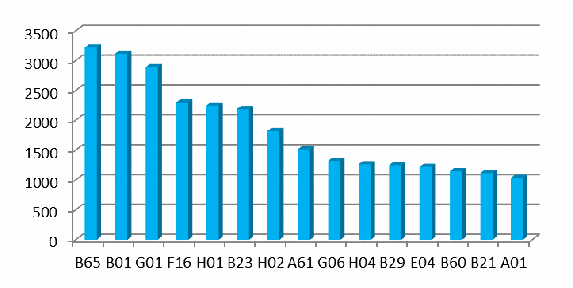
In 2022, patent pledge cases (based on the class and subclass of the IPC classification) are classified as follows:
[Number of pledged patents (Class)]
[Number of pledged patents (Subclass)]
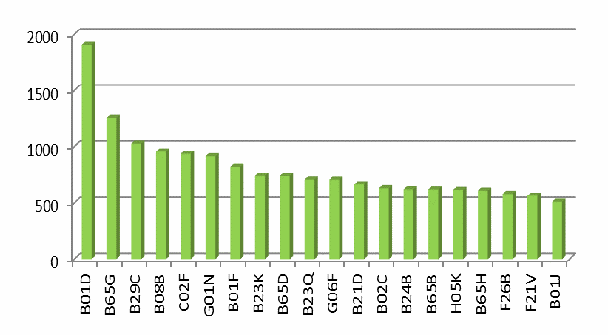
It can be seen that from the perspective of classes, B65, B01 and G01 have the most pledge cases; from the perspective of subclasses, B01D, B65G and B29C have the most pledge cases. B01 refers to general methods or devices in physics or chemistry, involved with many patent applications for environmental protection in pledge cases. B65G refers to transport or storage devices such as conveyors for loading or dumping, shop conveyor systems or pneumatic pipe conveyors. B29C refers to plastic molded connections.
Below is the table of the top ten applicants for the pledged patents in China from January 1 to August 1, 2022.
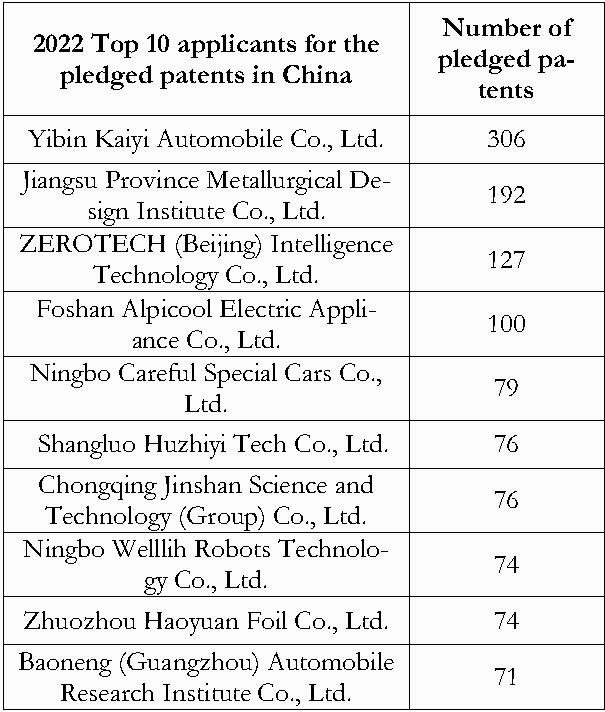
According to the above statistics, there are more applications involved in the automotive field, followed by the material field.
Below is the figure on the pledged patents owned by foreigners in China:
[Pledged patents owned by foreigners]
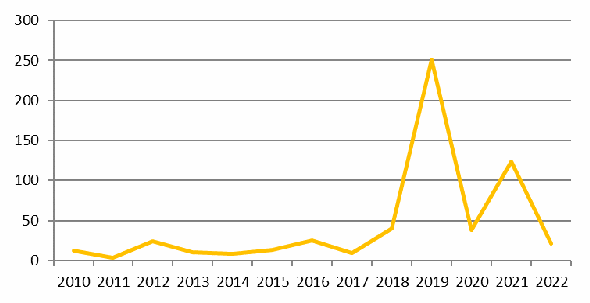
As can be seen from the figure above, the number of the pledged patents owned by foreigners is not large on the whole. Except for 2019 and 2021, the number of the pledged patents is less than 50. 2019 saw the largest number of cases. According to the investigation, half of the pledged patents owned by foreigners were pledged by the pledgors "Envision AESC Japan Ltd" and "Envision AESC Energy Components Co., Ltd.". The pledgee is Sumitomo Mitsui Banking Corporation.
V. Conclusions Patent right pledge plays a significant role in patent right operation. The number of cases about registration of the pledged patent rights in China has increased year by year. Especially, some policies and measures on the pledge of intellectual property rights introduced by China in recent years have contributed to a large number of the pledged patents. At the same time, we have also seen a rising number of the patents pledged by foreign patentees this year. I hope this article can give readers an overview of the information about the pledged patent rights in China, so as to facilitate their understanding of and insights into patent pledge systems in China.