
When calculating annuities for a client’s quotation, take care to use the correct starting point for each patent year. In China, years are counted from the filing date. In Japan, the first fee year begins with registration. The following example illustrates the difference; the appendix sets out the Chinese and Japanese fee schedules used in this article.
Example: a Chinese patent granted in the fourth year after filing
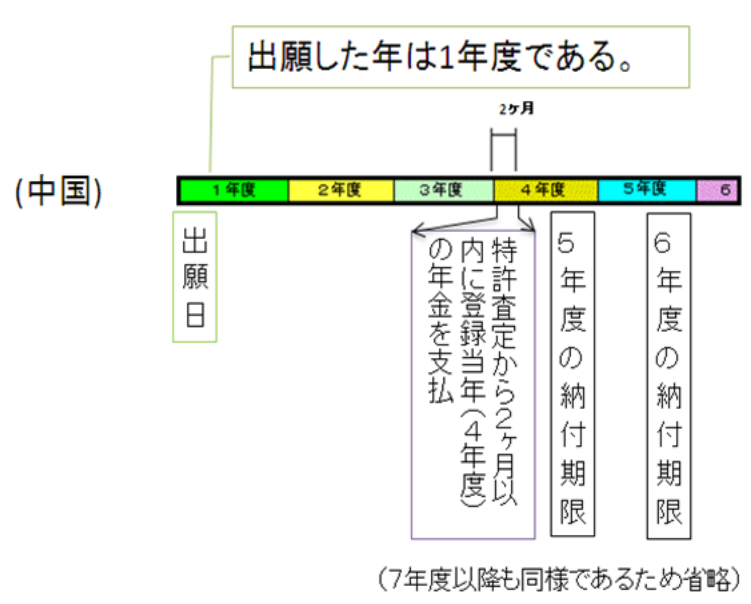
As Figure 1 illustrates, the fourth-year annuity—RMB 1,200—must be paid when completing the grant formalities, within two months of receipt of the notification. The year in question is the fourth patent year from filing. The former application maintenance fee system had been abolished, so maintenance fees for years one to three before grant are not payable.
From the fifth patent year onward, each year’s annuity must be paid before the end of the preceding patent year. If payment is not made in time, the late-payment procedure may be used.
Comparison with a Japanese patent
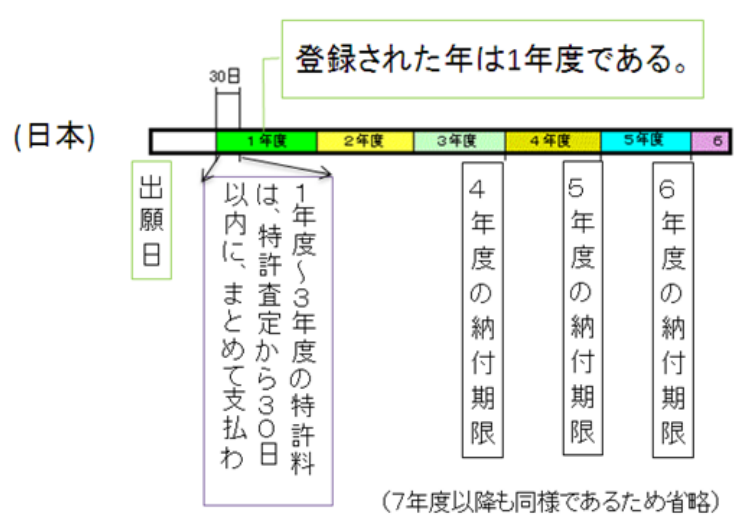
As Figure 2 illustrates, the fees for years one to three must be paid together within 30 days after service of the decision to grant. Here, year one runs from registration, unlike the Chinese patent year, which runs from filing.
From the fourth year after registration onward, the fee for each year must be paid before the preceding year ends. A late-payment procedure is available if the fee is not paid within that period.
The important distinction is therefore the starting date: filing in China, registration in Japan. This must be reflected in an annuity calculation.
Notes
1. Article 43 of the Chinese Patent Law requires a patentee to pay annual fees beginning with the year in which the patent right is granted.
2. Part V, Chapter 9, section 2.2.1 of China’s Guidelines for Patent Examination defines a patent year as a year counted from the filing date. It is independent of the priority date and grant date and does not necessarily correspond to a calendar year. For example, if the filing date is June 1, 1999, the first patent year runs from June 1, 1999 to May 31, 2000; the second runs from June 1, 2000 to May 31, 2001, and so on.
3. The currency conversion in the original fee comparison is RMB 1 ≈ JPY 16, as at October 2013.
Appendix: annual fee comparison
The amounts below reproduce the fee comparison for 2013. Chinese years are counted from filing and Japanese years from registration. The Japanese schedule applies to applications for which examination was requested on or after April 1, 2004. In the formulas, n is the number of claims. The Japanese fee rows extending to year 25 are fee bands and do not themselves confer a 25-year patent term; payment depends on the patent remaining in force, including any applicable term extension.
- Year 1: China — RMB 900 (approximately JPY 14,400); Japan — JPY 2,300 + n × JPY 200.
- Year 2: China — RMB 900 (approximately JPY 14,400); Japan — JPY 2,300 + n × JPY 200.
- Year 3: China — RMB 900 (approximately JPY 14,400); Japan — JPY 2,300 + n × JPY 200.
- Year 4: China — RMB 1,200 (approximately JPY 19,200); Japan — JPY 7,100 + n × JPY 500.
- Year 5: China — RMB 1,200 (approximately JPY 19,200); Japan — JPY 7,100 + n × JPY 500.
- Year 6: China — RMB 1,200 (approximately JPY 19,200); Japan — JPY 7,100 + n × JPY 500.
- Year 7: China — RMB 2,000 (approximately JPY 32,000); Japan — JPY 21,400 + n × JPY 1,700.
- Year 8: China — RMB 2,000 (approximately JPY 32,000); Japan — JPY 21,400 + n × JPY 1,700.
- Year 9: China — RMB 2,000 (approximately JPY 32,000); Japan — JPY 21,400 + n × JPY 1,700.
- Year 10: China — RMB 4,000 (approximately JPY 64,000); Japan — JPY 61,600 + n × JPY 4,800.
- Year 11: China — RMB 4,000 (approximately JPY 64,000); Japan — JPY 61,600 + n × JPY 4,800.
- Year 12: China — RMB 4,000 (approximately JPY 64,000); Japan — JPY 61,600 + n × JPY 4,800.
- Year 13: China — RMB 6,000 (approximately JPY 96,000); Japan — JPY 61,600 + n × JPY 4,800.
- Year 14: China — RMB 6,000 (approximately JPY 96,000); Japan — JPY 61,600 + n × JPY 4,800.
- Year 15: China — RMB 6,000 (approximately JPY 96,000); Japan — JPY 61,600 + n × JPY 4,800.
- Year 16: China — RMB 8,000 (approximately JPY 128,000); Japan — JPY 61,600 + n × JPY 4,800.
- Year 17: China — RMB 8,000 (approximately JPY 128,000); Japan — JPY 61,600 + n × JPY 4,800.
- Year 18: China — RMB 8,000 (approximately JPY 128,000); Japan — JPY 61,600 + n × JPY 4,800.
- Year 19: China — RMB 8,000 (approximately JPY 128,000); Japan — JPY 61,600 + n × JPY 4,800.
- Year 20: China — RMB 8,000 (approximately JPY 128,000); Japan — JPY 61,600 + n × JPY 4,800.
- Year 21: China — no amount listed; Japan — JPY 61,600 + n × JPY 4,800.
- Year 22: China — no amount listed; Japan — JPY 61,600 + n × JPY 4,800.
- Year 23: China — no amount listed; Japan — JPY 61,600 + n × JPY 4,800.
- Year 24: China — no amount listed; Japan — JPY 61,600 + n × JPY 4,800.
- Year 25: China — no amount listed; Japan — JPY 61,600 + n × JPY 4,800.
China’s former application maintenance fee was abolished from February 2010. Chinese grant-year annuities begin only upon grant; the rows for years one to three do not require payment of pre-grant maintenance fees. Chinese equivalents in Japanese yen use the original October 2013 conversion, not a present-day exchange rate.
Original references
http://www.furutani.co.jp/cgi-bin/term.cgi?title=%93%C1%8B%96%88%DB%8E%9D%94N%8B%E0
http://iprsupport-jpo.go.jp/syutsugan/pdf/Major.pdf