

In an administrative case concerning Google’s NEXUS application, the first- and second-instance courts refused registration because of Shimano’s earlier NEXUS mark for similar goods. On retrial, the Supreme People’s Court accepted the coexistence agreement between the companies, set aside the earlier judgments and allowed registration.
The case was among 27 selected cases concluded by the Supreme People’s Court in 2016.
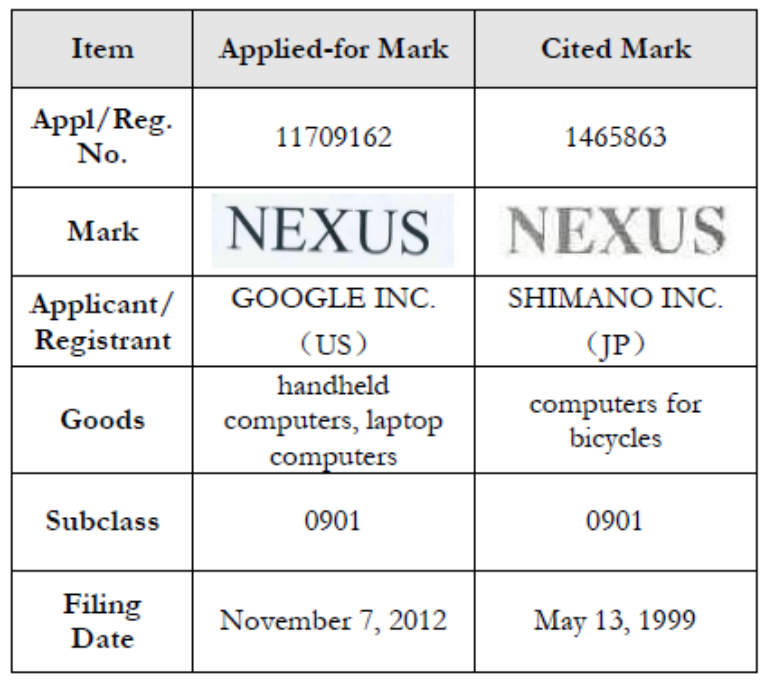
Trademark Office and Trademark Review and Adjudication Board: Registration Refused
Google’s mark and the cited mark were identical in letters and pronunciation. Google’s handheld and laptop computers were considered similar to the cited mark’s computers for bicycles. Registration was therefore refused under Article 28 of the 2001 Trademark Law.
First and Second Instances: Registration Refused
The courts considered the marks identical and the goods highly similar. Despite the coexistence agreement, they refused registration to maintain market order and avoid consumer confusion.
Supreme People’s Court: Registration Allowed
Case number: (2016) Zui Gao Fa Xing Zai No. 103.
The court found differences in the functions and consumers of the respective goods. Although the marks were identical, there was no evidence that coexistence would harm national, social or consumer interests. A consent letter is an exercise of the cited mark owner’s legal rights and should be an important consideration when applying Article 28.
Considering the presentation of the marks, the differences between the goods and the coexistence agreement, the court allowed registration.
Commentary
The agreement offers guidance for cases involving identical marks, distinguishable goods and companies with established reputations. The article cautions that coexistence agreements are unlikely to receive the same treatment where the goods are indistinguishable and the parties are small or ordinary companies.