
According to Article 8 of the Chinese Trademark Law, any sign that can distinguish the goods of a natural person, legal person or other organizations from those of others, including words, devices, letters, numbers, three-dimensional signs, colour combinations, sounds, as well as combinations of the above elements, can be applied for registration as a trademark. According to this provision, signs containing numbers alone or a combination of numbers and other elements can be registered as trademarks. Signs containing numbers are very popular with many businesses as they are simple, easy to remember and convenient for publicity, but these marks may also be rejected in the registration process for various reasons.
The author has made a brief summary of the possible reasons in the hope that applicants will be aware of them and avoid the result of rejection.
I. Types of trademarks containing numbers
Trademarks containing numbers include trademarks composed solely of numbers, as well as trademarks combining numbers with other elements such as words and/or devices, etc. Roman numerals such as “I, II, III” are regarded as devices in the trademark examination process, so the discussion here is mainly about Arabic numerals and Chinese numerals.
II. Reasons for refusal of trademarks containing numbers
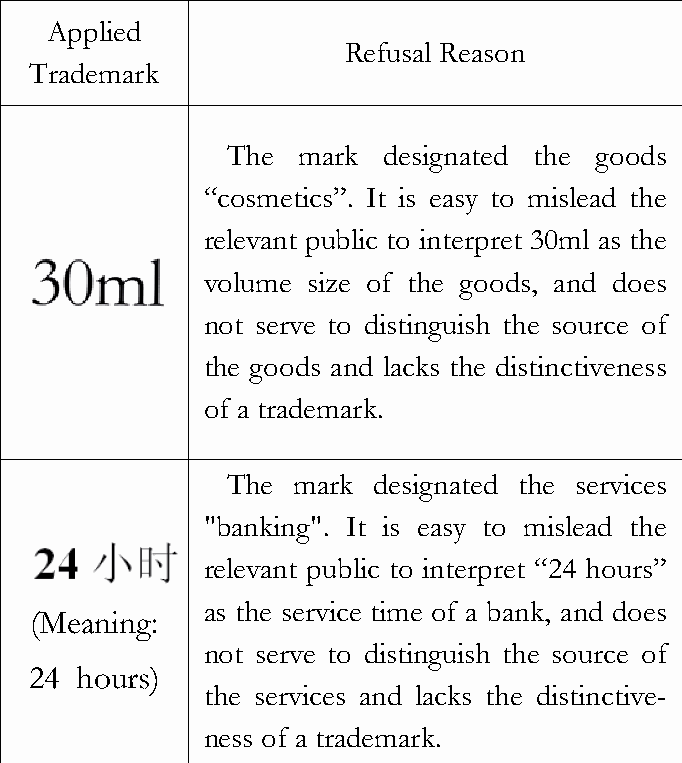
1. Trademarks that are deceptive and likely to mislead the public as to the quality, time, weight, quantity, price and other characteristics of the goods.
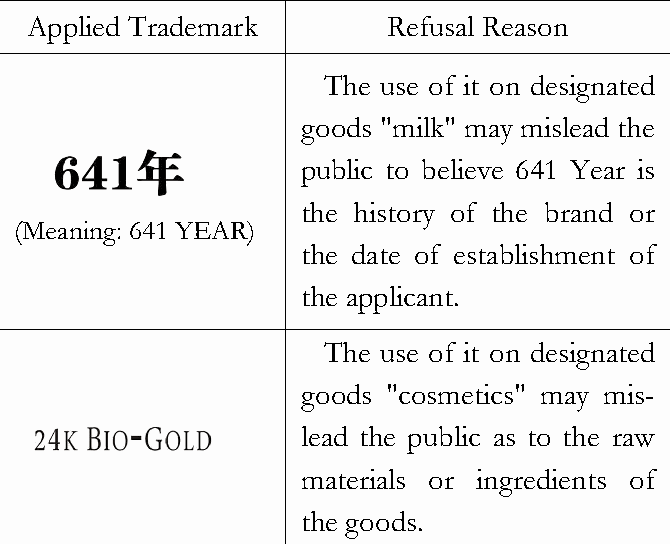
If the numbers in the mark do denote some actual characteristic of the goods, or if the relevant public would not consider the numbers to have any relationship to the characteristics of the goods, the trademark may be registered.
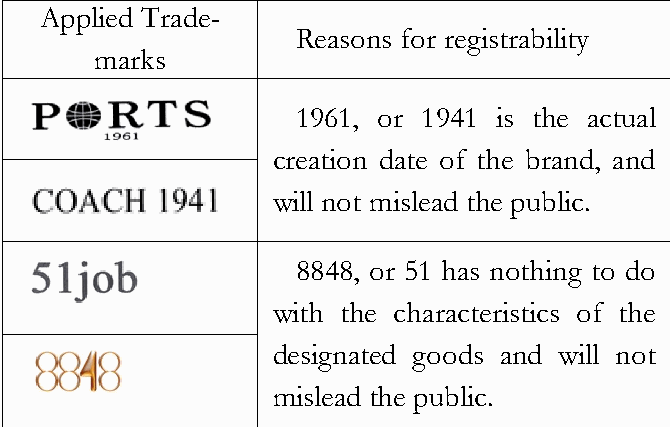
The determination of whether a trademark is deceptive should take into account the characteristics of the designated goods. For example, the use of mark "24K" on "jewellery" is likely to cause misunderstanding of raw materials of the goods, while the use of same mark on "meat" is less likely to cause misunderstanding.
2. Trademarks that harm socialist morality or have other adverse effects
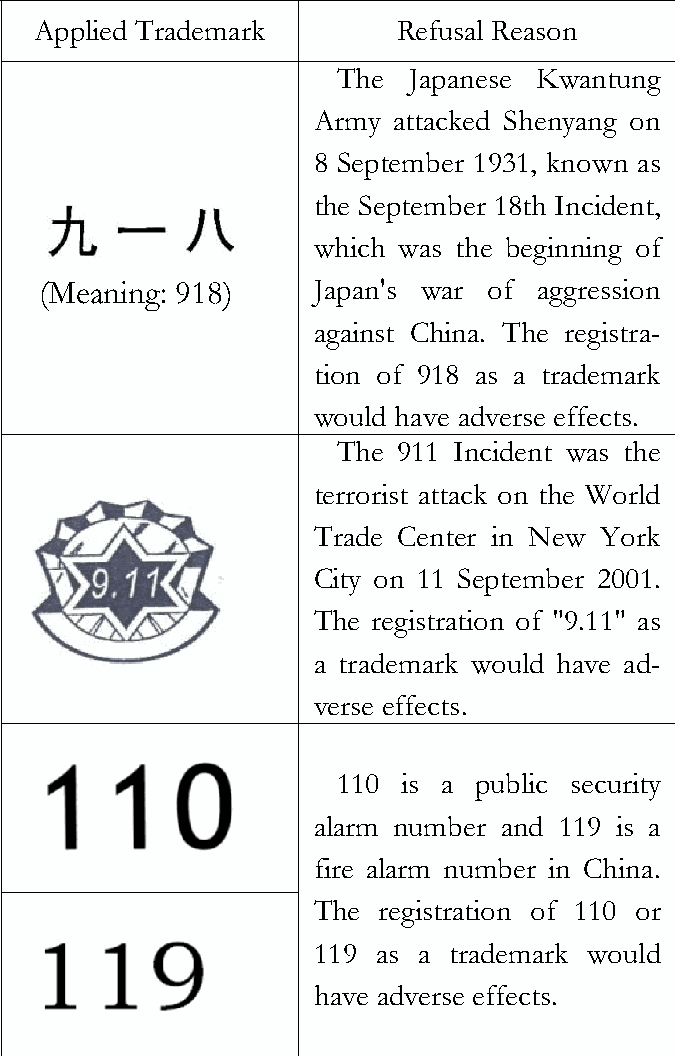
If a sign is deceptive, easy to mislead, or has some kind of adverse effect, then the sign cannot be used as a trademark and cannot be registered as a trademark, including not being allowed to be registered on the grounds that it has been used.
3. Trademarks that lack distinctive features
The lack of distinctive features of a trademark containing numbers mainly contains two situations.
(1) The trademark is too simple, or the form is too common.

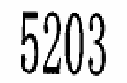
(2) The trademark contains only the model number of the goods, or only directly indicates the quality, the main raw materials, function, use, weight, quantity and other characteristics of the goods.
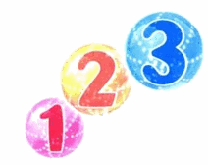
A registration may be granted if the number in the mark is not in its ordinary expression, or it is combined with other elements such as words or devices and has a distinctive character as a whole.

A specific analysis on the characteristics of the designated goods must be made when determining whether the mark lacks distinctiveness. For example, the mark "fifty degrees" cannot be registered on the goods "liquor" as it directly indicates the alcohol content, but when used on "downloadable computer applications", "fifty degrees" can be registered as it does not directly indicate any characteristics of the goods.
4. Marks Identical or Similar to Another Party’s Earlier Trademark
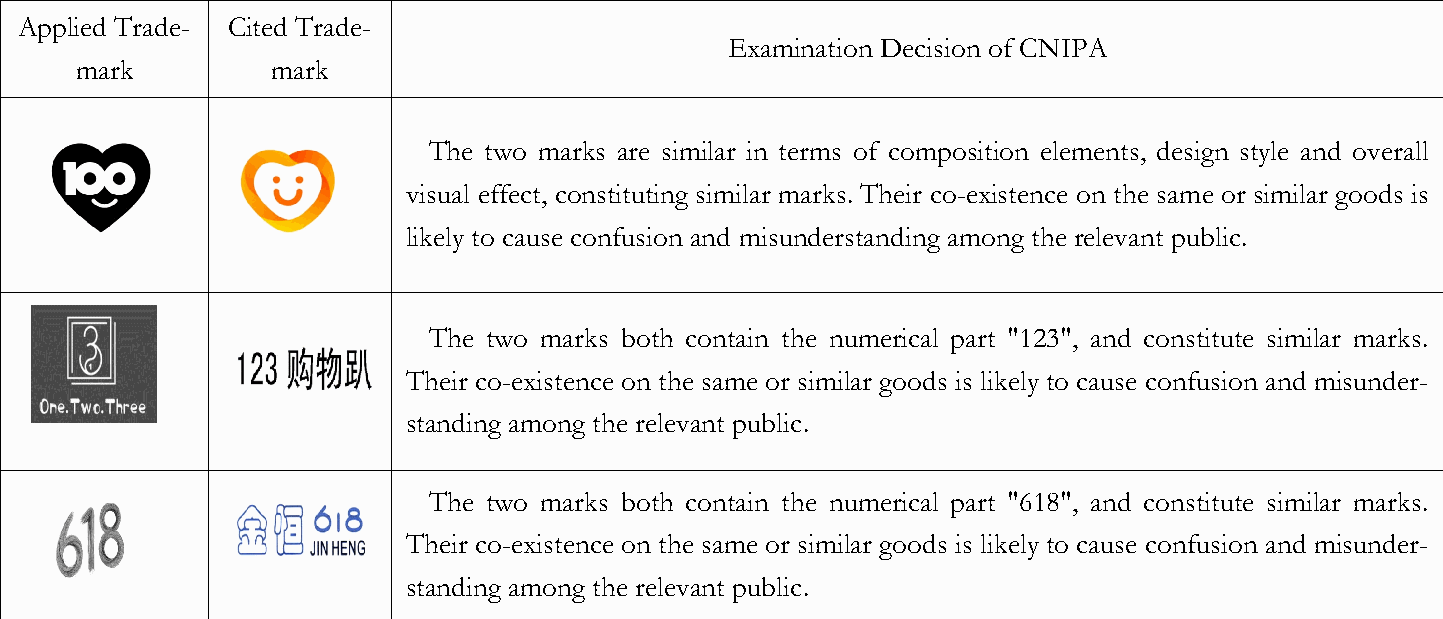
A trademark containing numbers may be similar to an earlier mark because of the meaning or graphic design of those numbers. A combination of numbers, words and devices may also be considered similar to an earlier mark on the basis of the numerical element alone.
III. Suggestions for Applications to Register Trademarks Containing Numbers
Purely numerical marks generally have weak distinctiveness and face a relatively high risk of refusal. Applicants may consider using stylized or artistic numerals, or combining them with words or devices, to make the mark distinctive as a whole and improve its prospects of registration.
Distinctiveness may be inherent or acquired through use. Extensive use and a sufficient level of recognition may enable a numerical mark to acquire distinctiveness. For example, Boeing’s “737” mark consists of three ordinary numbers and inherently lacks distinctiveness. However, the applicant submitted sufficient evidence that the relevant public had become familiar with the mark through use and would generally associate it with the applicant. It could therefore distinguish the source of the goods and had acquired sufficient distinctiveness to be registered.
Applicants seeking to enter the Chinese market should also familiarize themselves with Chinese culture, consumers and history, or instruct a local agency to conduct a professional search. This can help avoid applications for numerical marks such as “918” (referring to the September 18 Incident during Japan’s invasion of China) or “512” (the date of the 2008 Wenchuan earthquake), which may have adverse social effects.